
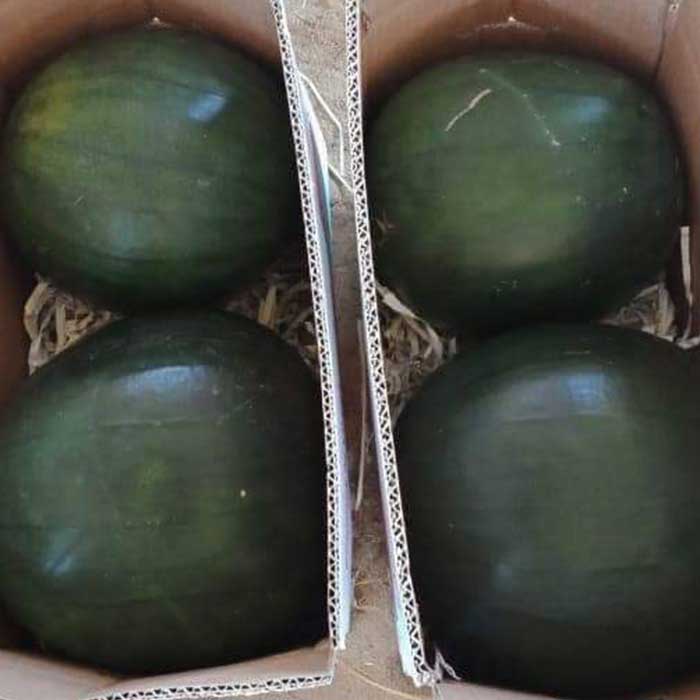
Fresh Water Melon from Egypt
exporter and supplier for importers, wholesalers and distributors
Egyptian Watermelon Exporter
Aton Green Egypt is an Egyptian exporter and supplier of fresh watermelons (Citrullus lanatus) for importers, wholesalers, distributors and supermarket chains in Europe, the UK, Canada, Asia and the Gulf.
The Egyptian watermelon is a large, round to oval fruit with a hard, smooth, dark-green rind. Its deep red flesh is tender, crisp and juicy, with a very sweet, refreshing flavor.
Giza Watermelon
Giza is Egypt's leading watermelon variety, developed by the Egyptian Agricultural Research Centre: a round fruit with a dark-green rind, heavy weight and high sugar content (Brix 12–13).
Skata Watermelon
Skata (also known as Escatta or Sakata) has a smooth dark-green rind and deep red, very sweet and crisp flesh, and is one of the most popular watermelons in Egypt's markets. Both varieties are graded by weight from 4 to 13 kg per fruit.
Why Import Watermelons from Egypt?
Egypt's warm climate brings an early watermelon harvest from April, ahead of the main southern European crop, with supply continuing until October. Short sea routes from Alexandria, Damietta and Ain Sokhna deliver watermelons in reefer containers to Europe and the Gulf.
Watermelon Packing Details
| Carton | Bin | |
|---|---|---|
| Varieties: | Giza, Skata | |
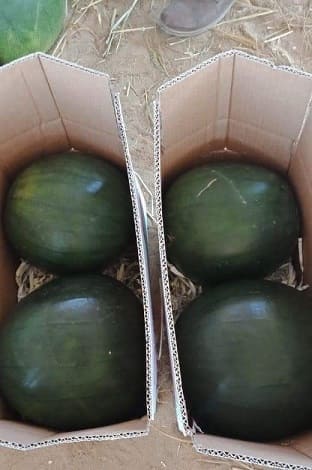
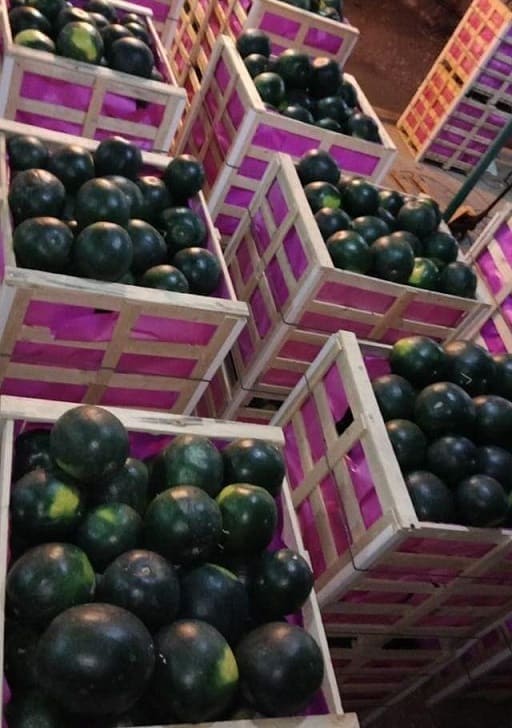
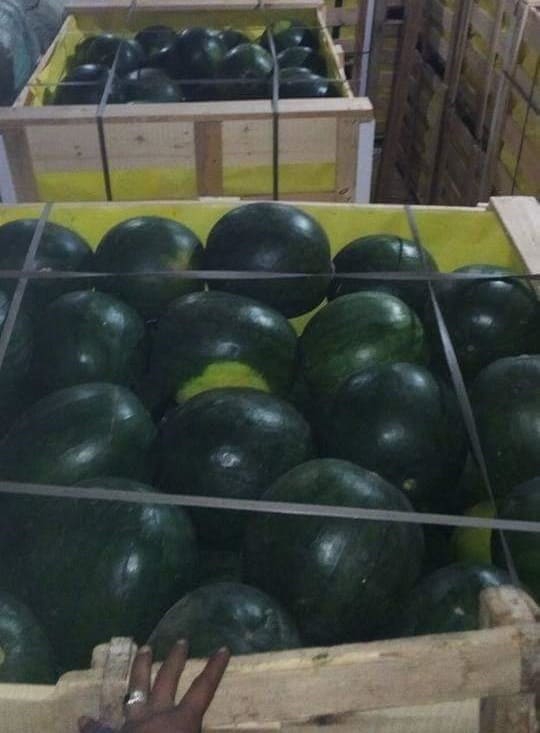
| Packing: | Carton 12–15 kg | Bin 1,250 kg |
| Watermelons per Pack: | 2–3 pieces | Approx. 100–300 pieces (by fruit size) |
| Fruit Weight: | 4–13 kg | 4–13 kg |
| Cartons / Bins per Pallet: | 80 cartons | 1 bin |
| Cartons / Bins per Container: | 1,600 cartons | 20 bins |
| Pallets per Container: | 20 (40 ft reefer) | 20 (40 ft reefer) |
| Pallet Dimensions: | 1 × 1.2 m | 1 × 1.2 m |
| Container Weight: | approx. 20–24 tons | approx. 25 tons (20 × 1,250 kg) |
| Storing: | 10–15 °C (7–10 °C for long transit), 2–3 weeks | |
| Humidity: | 85–90% | |
| PRODUCT | VARIETIES | JAN | FEB | MAR | APR | MAY | JUN | JUL | AUG | SEP | OCT | NOV | DEC | |
|---|---|---|---|---|---|---|---|---|---|---|---|---|---|---|
 |
Watermelon | Giza, Skata | 4 | 5 | 6 | 7 | 8 | 9 | 10 |
FAQ About Watermelons
How can I import fresh watermelons from Egypt?
Contact Aton Green Egypt with your company details, destination country and port, required variety, fruit weight, packing (carton or bin), number of containers and preferred shipment dates. Our team will confirm availability and send you an export quotation.
Which watermelon varieties do you export from Egypt?
We export two Egyptian watermelon varieties: Giza, Egypt's leading watermelon variety, developed by the Egyptian Agricultural Research Centre, with a round shape, dark-green rind, heavy weight and high sugar content (Brix 12–13), and Skata (also written Escatta or Sakata), with a dark-green rind and deep red, very sweet flesh. Both have crisp, juicy flesh and a strong rind for sea shipping.
When is the Egyptian watermelon export season?
Our watermelon export season runs from April to October. The main open-field crop is harvested from late April to August, and later plantings in Upper Egypt extend supply into September and October.
Which countries do you export Egyptian watermelons to?
We supply importers, wholesalers and supermarket suppliers in the Gulf, including Saudi Arabia, the UAE and Qatar, and in Europe, including the Netherlands, the UK, Italy, France and Germany, as well as Canada, Asia, including Japan, Taiwan, Singapore and Malaysia, and other markets worldwide.
What sizes of Egyptian watermelons are available?
Our export watermelons are graded by weight, usually 4–6 kg for retail packs, 6–9 kg for general wholesale and 9–13 kg for the catering and juice trade. Other weight ranges can be packed on request.
How are Egyptian watermelons packed for export?
Watermelons are packed in 12–15 kg corrugated cartons (2–3 fruits per carton), about 80 cartons per pallet and 1,600 cartons per 40 ft reefer container, or in bulk bins of 1,250 kg on pallets, each holding about 100–300 watermelons depending on fruit size (20 bins per 40 ft reefer container). Private label cartons can be arranged on request.
How are fresh watermelons stored and shipped?
Watermelons are shipped in 40 ft reefer containers at 10–15 °C with 85–90% relative humidity, or 7–10 °C for longer transits. Under these conditions they keep for about 2–3 weeks. Temperatures below about 7 °C can cause chilling injury.
© 2026 Aton Egypt